Why ExotechHub Uses ISO Principles in Multidisciplinary Technology Projects
At ExotechHub, we believe that a successful technology project is not only about building something that works. It is also about having a clear process to understand requirements, manage risks, test results, document decisions, and continuously improve the solution.
For this reason, we incorporate relevant ISO principles and quality-management practices into our project processes when appropriate.
What does ISO mean for a technology project?
ISO standards provide internationally recognized frameworks for managing processes, quality, risks, information, and continuous improvement.
We do not treat ISO as unnecessary bureaucracy. Instead, we use relevant principles as a practical framework to make projects more organized, measurable, and traceable.
The specific approach depends on the type, scope, and requirements of each project.
A Multidisciplinary Approach
Technology projects increasingly involve more than one area of knowledge.
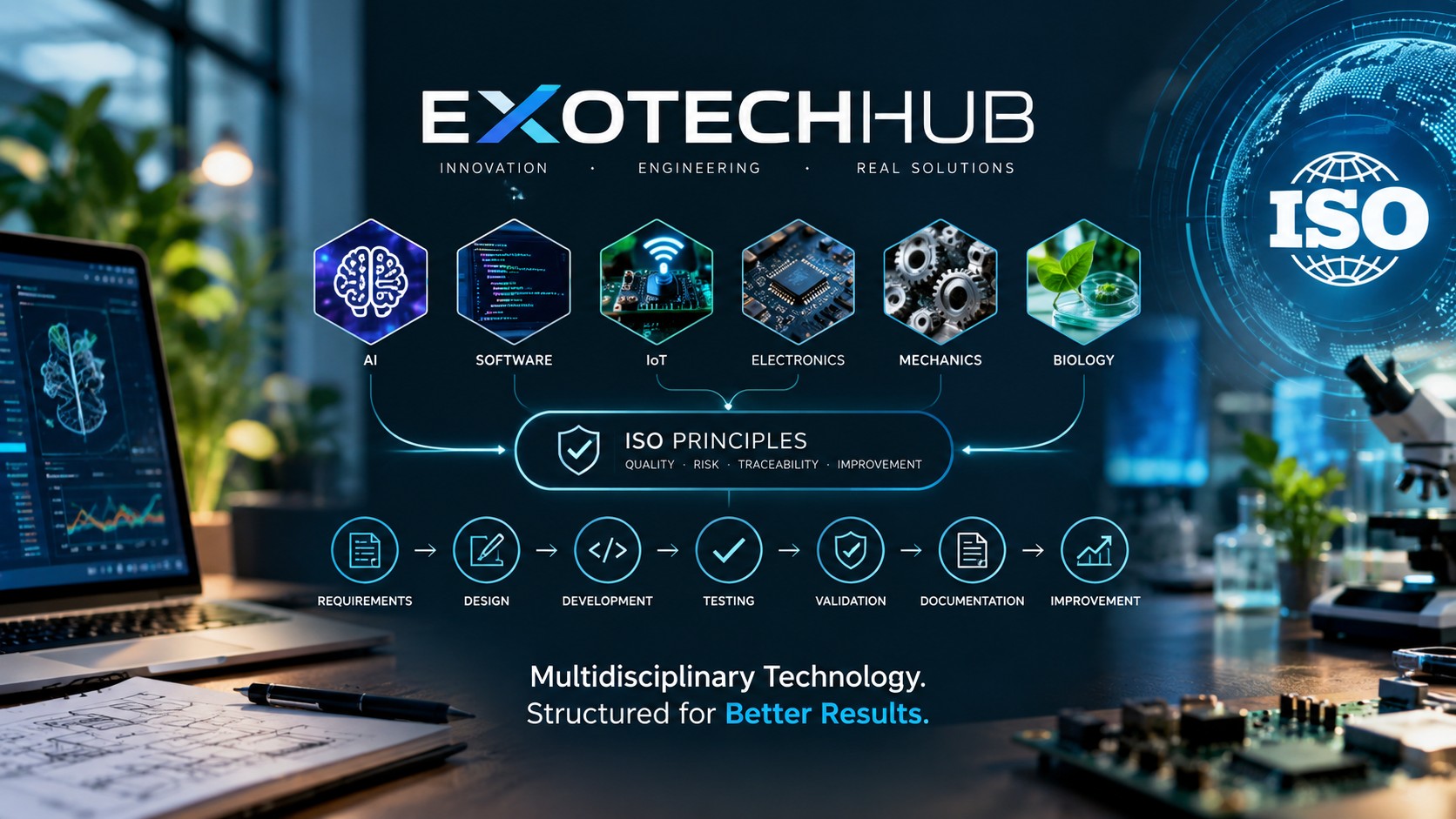
At ExotechHub, we work with multidisciplinary projects that can combine software, artificial intelligence, electronics, IoT, mechanics, data, and biological or experimental applications.
A project may require a combination of different technologies and engineering disciplines. In these situations, having a structured process becomes even more important.
For example, an IoT project may involve:
- Electronic sensors and embedded systems
- Software and backend development
- Data collection and storage
- Artificial intelligence and data analysis
- Mechanical components or enclosures
- Experimental or biological variables
Rather than treating each component as an isolated system, we consider how the different parts work together as one project.
How we apply these principles
Our projects can follow a simple structure:
Requirements → Design → Development → Testing → Validation → Documentation → Improvement
This helps us maintain a clear connection between what the client needs, what we build, and how we verify the results.
For example, a project may include:
- Clearly defined requirements
- Risk identification and management
- Documented technical decisions
- Testing and validation procedures
- Data collection and traceability
- Version and change management
- Project documentation
- Continuous improvement
The objective is simple: build the right solution and have a clear way to demonstrate that it works.
What does this mean for our clients?
Using structured quality and process principles can provide several practical benefits:
Clearer requirements
Everyone has a better understanding of what needs to be built.
Better documentation
Important technical decisions and project information are recorded and easier to maintain.
More structured testing
Solutions are tested against defined requirements rather than simply assuming that they work.
Greater traceability
Data, changes, tests, and results can be tracked throughout the project.
Easier maintenance
A well-documented system is easier to understand, modify, and improve.
Continuous improvement
Lessons learned from testing and operation can be used to improve future iterations.
Technology with a Structured Approach
At ExotechHub, we combine technology, engineering, data, and AI with practical quality-management principles.
The goal is not to add unnecessary complexity to a project.
The goal is to reduce unnecessary complexity, improve reliability, and create solutions that can be understood, tested, maintained, and improved over time.
For each project, we determine which practices and standards are relevant based on its specific requirements.
Learn More About ISO Standards
ISO develops and publishes international standards covering a wide range of industries, technologies, and management practices.
To learn more about ISO standards and the work of the International Organization for Standardization, visit the official ISO website:
International Organization for Standardization (ISO)
Building better technology, one structured project at a time.
Need help with a software, AI, IoT, electronics, or multidisciplinary technology project?